
No Gift Refused
Stack 18

Last week I left you with the three of us settled into John’s house and my version of Red Red Groove playing its very first show. What came next was, honestly, one of the best stretches of my life.
1989 felt like the world was finally opening up.
By day — or whatever passes for day when you keep club hours — Mike and I were practicing regularly, writing songs, and figuring out what this incarnation of Red Red Groove was supposed to sound like. By night, I was behind the turntables at The Max, getting better every weekend, diving deeper into the music. The two things fed each other in ways I didn’t fully appreciate at the time. What I was learning about dance floors and crowd energy went directly into how we approached the band and the planning of our live shows. And what I was learning about songwriting and arrangement made me a better DJ, finding new ways to weave songs together on the dance floor. I was living inside music, and I loved every minute of it.
The social obligations that came with living in John’s world were another story. He was supportive of the band — genuinely, enthusiastically supportive — but he also had expectations about our presence in the bar scene. We had to be seen. That meant parties at the local drug dealer’s place, the club video producer’s trailer conveniently hidden behind the dry cleaners, and random gatherings at other bar people’s houses. I was still under twenty-one for most of this, so the actual bars weren’t an option during the week. But the parties were. And the parties always had drugs. Always. I took part when I felt like it, but it wasn’t really my scene. Beer was about all that was ever on offer at those things anyway — liquor stores closed at nine, so everyone would bolt a few minutes early to grab whatever they could from the gas station before last call, and that was your selection for the night. I would usually nurse one beer all evening and count the minutes. I would have rather been home working on music. John saw it differently. Appearances mattered. So, we appeared.
The practice sessions with Mike were a different universe entirely. We’d work through our songs in his parents’ rec room, and Mike would regularly swap in ridiculous alternate lyrics mid-song just to crack me up. Beyond the laughs, though, those sessions were where we figured out who we actually were as a band. We discovered that in addition to Duran Duran and Joe Christ’s DIY spirit, we were both devotees of John Waters and a mostly unheard-of band called Until December. At least they were unheard of in Oklahoma. To this day, their first album is still one of my favorites. Before long, we’d added their song No Gift Refused to our live set, and honestly, I wish we’d recorded our version. It was good.
Beyond that shared core, there was a mutual love of synthpop and new wave. Dead or Alive. Depeche Mode. Where we differed was on the extremes. Mike leaned more artsy and esoteric — there were alternative acts he loved that just didn’t do it for me. I leaned toward hardcore punk. Black Flag. N.O.T.A. You know the old shirt — “Fuck Art, Let’s Kill.” That’s always been more my lane.
But those different extremes with a common middle made for something interesting. We were DIY punk in spirit, drawn to synthpop and technology by genuine curiosity, and pop-sensible enough to write hooks. People were calling it industrial, but we didn’t sound like anyone else in that category. That was satisfying. I’ve held onto that instinct ever since — if I don’t feel like I’m doing something unique and don’t genuinely enjoy listening it, I probably shouldn’t be a part of it.
By 1990, Red Red Groove had real momentum.
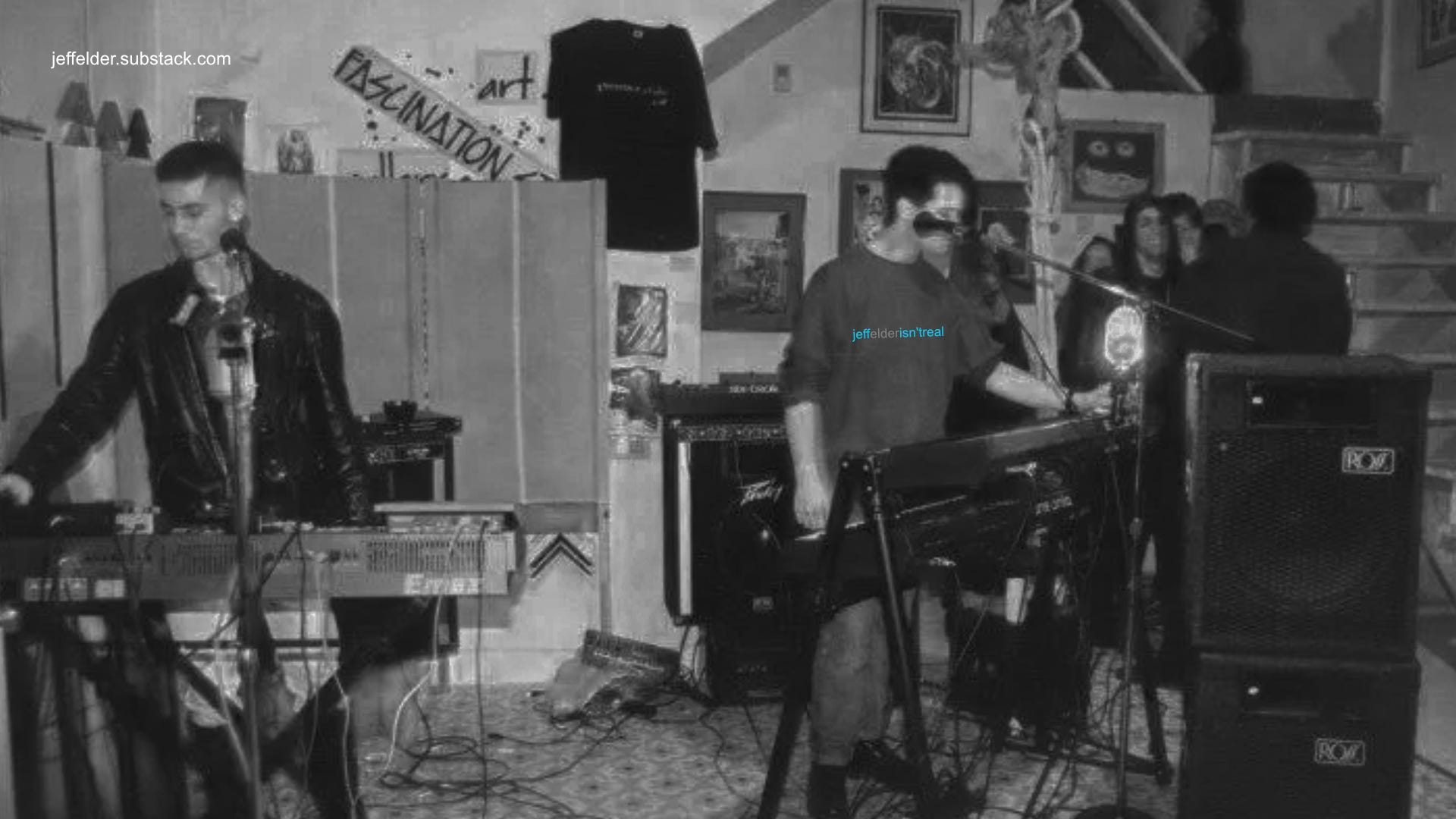
Early in the year, we played an art gallery show at a place called Fascination Street. Nine Inch Nails were in town the same night, opening for Peter Murphy. As I understand it, Trent stopped in and caught part of our set. We had no idea who was in the room — Trent really wasn’t anybody at that time - we were playing music, doing our thing — and I think they were gone before we finished. Our newly hired manager, Davit Souders, who had his hands in most anything that mattered on the alternative scene, somehow got us on the upcoming Pretty Hate Machine tour bill from there.
Our first show with Nine Inch Nails was on June 23rd, 1990 at the Cain’s Ballroom in Tulsa.
That show changed things. Locally, it was probably the moment we went from being just another local band to something people started taking a little more seriously. For the most part, back then, “local” bands didn’t play The Cain’s. We gained a lot of fans from those Nine Inch Nails shows. We also learned a few things along the way. DAT players are more reliable than sequencers. If a drug deal goes bad in the parking lot, the safest place is under the stage. And good, strong hair matters — at the Oklahoma City show, the singer from one of the other opening acts had been passing around a bottle of tequila all night and passed out mid-set. A roadie had to haul him back onto the stage by grabbing a fistful of hair and pulling. That must be why long hair became such a staple in the industrial scene. Structural integrity.
In addition to Nine Inch Nails, that period brought shows with Front Line Assembly, A Split Second, and several others. Someday, I need to put together a proper scrapbook page with all the old flyers before I’m too senile to remember which show was which. If you remember seeing us play with someone and want to know more about it, let me know, and I’m sure it will jar some memories that I’d be glad to share.
The Consolidated shows deserve their own mention, though. When we were booked to play with them the first time, we knew their music but hadn’t connected the dots on who they actually were until a week or two before the show. Turns out, Adam and Mark were from Until December. Mike and I completely lost our minds. At sound check, we played our version of No Gift Refused. Adam came out from the back — we hadn’t met yet — fist pumping on the dance floor with a huge smile on his face. From there, every show we did with them was good energy. They were also responsible for killing more sound systems with sheer bass pressure than any other band I’ve ever shared a stage with. Genuinely nice guys, though. Every time.
We were also putting together our first album, Demolition, during this stretch. The liner notes say 1990, which I’ll take as authoritative since my memory gets fuzzy on release dates. What I do remember is making promo copies on John’s Nakamichi cassette deck — high-quality dupes with dot matrix computer-generated labels, sent off to clubs or handed out to anyone who might listen. I must have made over a hundred of those tapes. Anything to get the music heard.
Looking back, 1989 and 1990 were the cloud nine years. The DJ career was clicking. The band was building. John was in our corner. It genuinely felt like we were on the path to something real. Life was exciting in the way it only is when you're young enough to believe the momentum will just keep going. I'm grateful for every bit of it. Not every kid who drops out of high school with a Casio and a dream gets to open for Nine Inch Nails at the Cain's Ballroom two years later. No gift refused, indeed.
I’ve always loved roller coasters. My personal thrill ride had begun, and I wanted more.
More road ahead next week. Make yours a good one.
Jeff
PS: Here’s a video I found online of one of our first performances together at TuCCA, from 1989. For those of you still in Tulsa, I hear that this same building is now a club called The Majestic.
This was before Ross had officially become a member of the band. We were toying with video, but did not have the full-screen thing going on like we eventually did with Ross on board.